01 · SEGMENT
Which SKUs matter most?
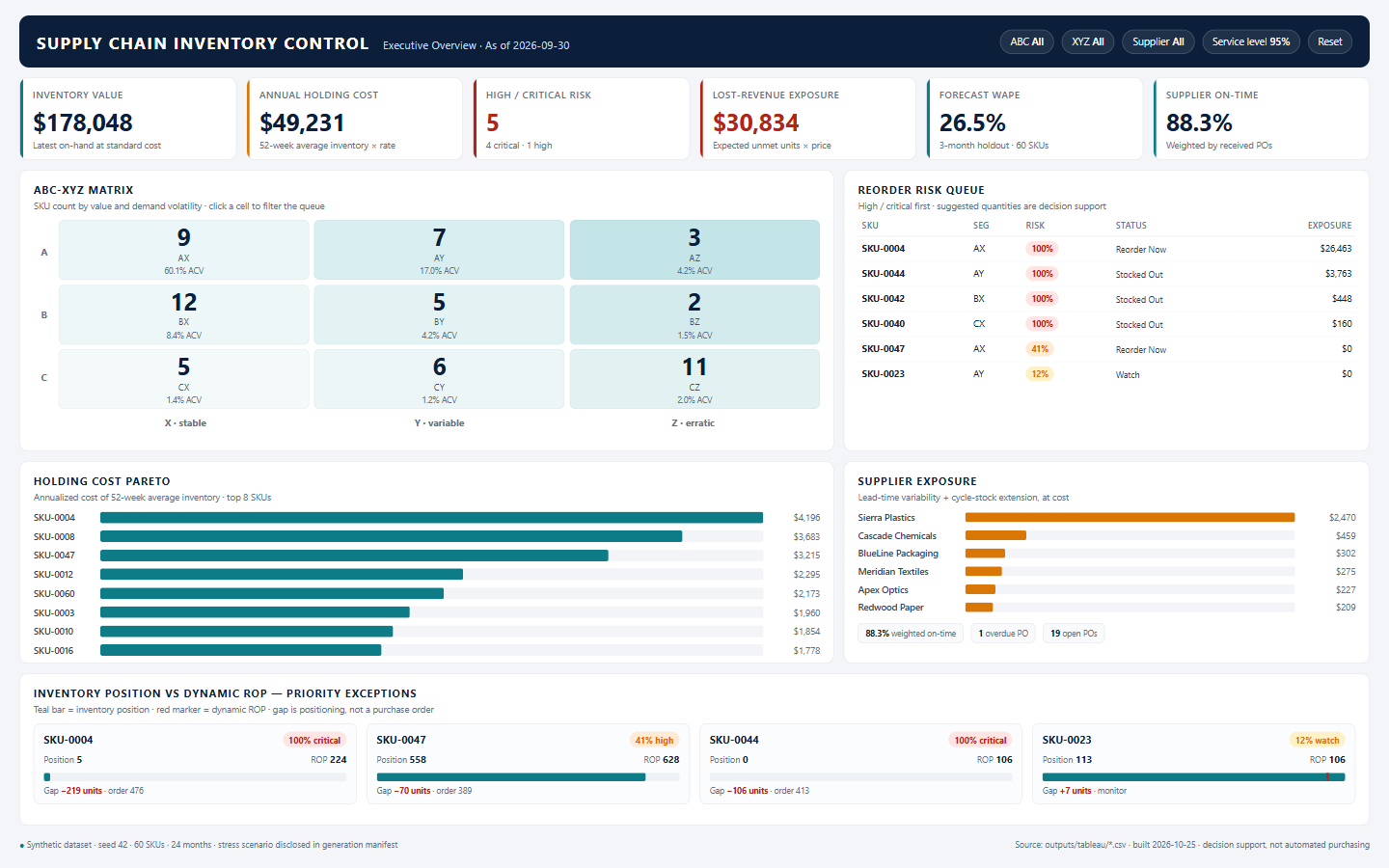
Value-based ABC classes meet calendar-complete demand variability (XYZ), exposing the high-value, hard-to-forecast items that deserve planner attention.
ABC-XYZSupply chain analytics · Portfolio project
A complete inventory control workflow built on two years of synthetic operating history — ABC-XYZ segmentation, economic order quantity, service-level safety stock, demand forecasting, Monte Carlo stockout risk, and supplier lead-time exposure.
Executive overview · ABC-XYZ heatmap, working capital, risk queue, and supplier performance.
 Open live preview
What the analysis answers
The pipeline is deliberately database-optional and fully reproducible. Each layer answers a different planning question and feeds the next.
Value-based ABC classes meet calendar-complete demand variability (XYZ), exposing the high-value, hard-to-forecast items that deserve planner attention.
ABC-XYZEOQ sets the economic order quantity. Service-level safety stock and reorder points are calculated at 90%, 95%, and 99%, with the target policy applied per SKU.
EOQ · SS · ROPETS and Holt-Winters forecasts feed a 20,000-run lead-time demand simulation. The output is a stockout probability, revenue exposure, and a suggested action.
Forecast · Monte CarloAssumptions, formulas, schema, and the dashboard field contract.
Python 3.11+. Deterministic seed. No database required for the core pipeline.
Source code, tests, SQL, dashboard specification, and the full analytical narrative are public. The dataset is synthetic and clearly labeled.